

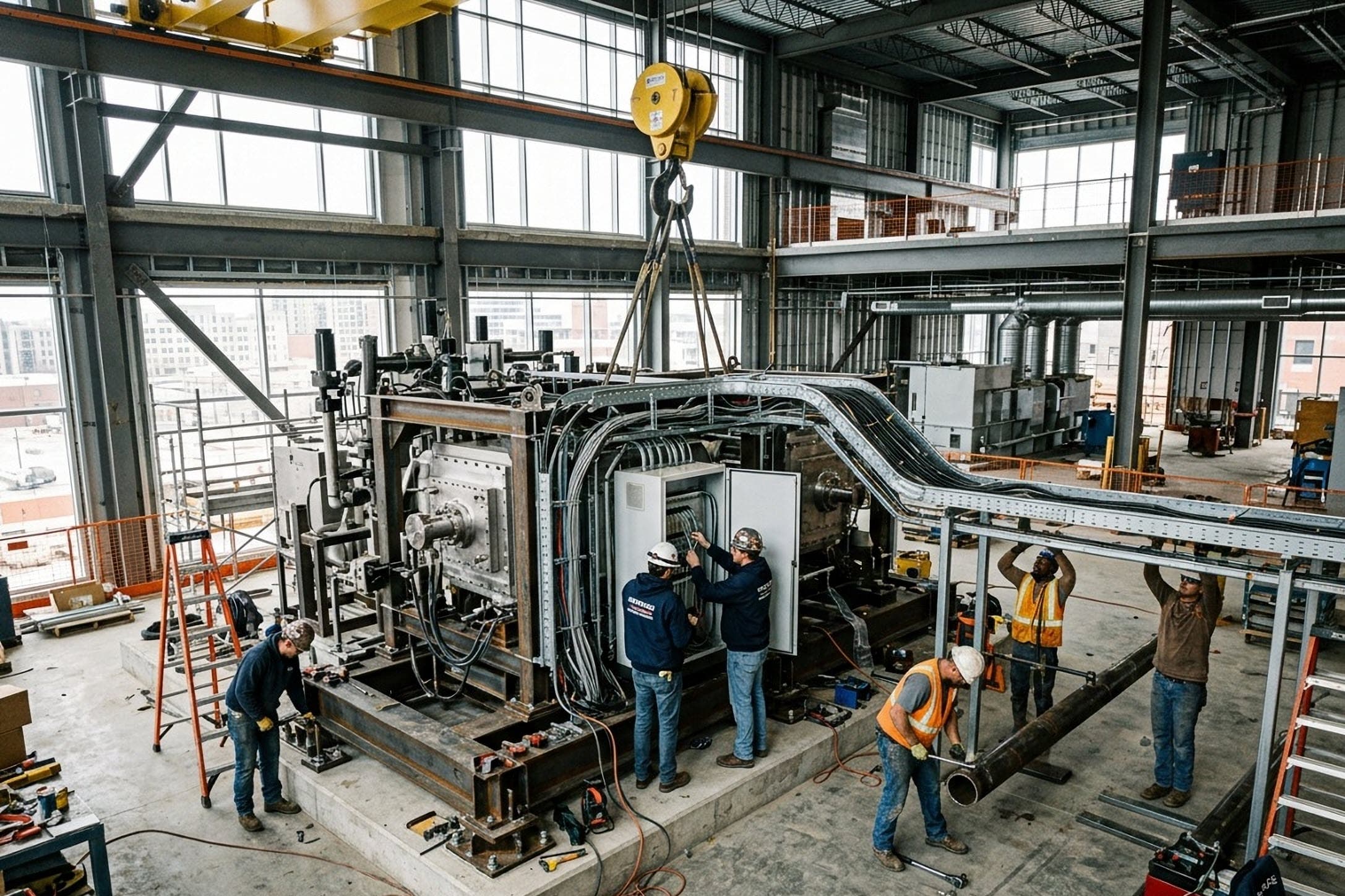
For companies that manufacture, supply, or install complex equipment on California construction projects, a recent appellate decision raises the stakes around contractor licensing. Whether a license is required in these situations often turns on detailed, project-specific facts and may not be resolved early in a case. This reality affects risk, leverage, and how projects should be documented from the outset.
In its recently published decision in AVL Test Systems, Inc. v. Hensel Phelps Construction Co., the Fourth Appellate District of the California Court of Appeal revived an equipment supplier’s claims that had been dismissed on licensure grounds under Business and Professions Code sections 7031 and 7045. Section 7031 imposes significant consequences on contractors who perform work without a valid contractor’s license, including the forfeiture of compensation for services rendered. Section 7045, however, provides an important exception, exempting from those requirements “the sale or installation of any finished products, materials, or articles of merchandise that do not become a fixed part of the structure.”
In the AVL case, the trial court had concluded that the installed equipment became a “fixed part of the structure” and that the supplier therefore needed a license. The appellate court held that the issue is one of fact. Because both sides presented competing evidence, the question could not be resolved on summary judgment by the court and had to go to trial.
Disputes over whether equipment becomes a “fixed part of the structure” are unlikely to be decided at the outset of a case. The analysis depends on how the equipment is actually installed, connected, and used, which requires factual development rather than a purely legal determination.
The trial court had treated the issue as a matter of law, relying on the contract and the nature of the work described. The Court of Appeal rejected that approach, emphasizing that the inquiry depends on real-world conditions. This makes resolution via a pretrial decision by the trial court far less likely.
First and foremost, the case underscores the draconian nature of Section 7031—an otherwise valid claim can be dismissed absent substantial compliance with California licensing law. The case also put emphasis on the critical role of expert testimony. Detailed, well-supported expert opinions can create a triable issue of fact on their own, making them a key factor in whether a case proceeds to trial.
AVL put forward detailed expert declarations, including one from a former senior official at the Contractors State License Board, explaining why the equipment should not be considered a permanent part of the structure. The appellate court made clear that this type of evidence must be taken seriously.
Rather than setting a bright-line rule, the court outlined an eleven-factor framework to guide the analysis. The focus is on practical considerations tied to installation, removability, and how the equipment functions in relation to the structure.
The factors include how difficult the equipment is to install or remove, whether removal would cause damage, how permanent the connections are, and whether the equipment is designed to be reused or operate independently. The outcome will depend on detailed, project-specific facts.
The decision rejects a restrictive reading of the section 7045 exemption. The appellate court focused on the statutory language and concluded that the exemption can apply more broadly where its terms are satisfied.
By emphasizing the word “any” in the statute, the court declined to treat the exemption as a limited carve-out. This interpretation expands the range of situations where companies may rely on the exemption.
The court also addressed arguments based on a party’s own conduct. A company’s belief that a license was required, or the fact that a license was issued, does not resolve the legal question.
The analysis remains objective and grounded in the statute. Those facts may be considered, but they are not determinative.
For companies operating in this space, licensing risk should be evaluated and documented early. A critical part of that early assessment is determining whether the business falls within the grey area of licensure requirements. The line between exempt and non-exempt work is rarely clear-cut, and the consequences of getting it wrong, i.e., operating without a required license, are often severe, including voided contracts, exposure to disgorgement, and the inability to enforce payment.
Where there is genuine uncertainty about whether a license is required, businesses should seriously consider erring on the side of obtaining one. When a dispute does arise, it is essential to engage qualified experts, document how equipment is installed and whether it can be removed or reused, and build a record that supports the application of the section 7045 exemption where appropriate. It also means planning for the possibility that these disputes will not be resolved quickly. When the “fixed part of the structure” question is in play, it is likely to be decided at trial.

Laurence focuses his practice on representing contractors, subcontractors/suppliers, developers and public agencies in all aspects of private and public works contracting. He handles a range of issues including contract drafting and negotiations, prevailing wage law counseling, bid protest, resolution of claims arising prior to project completion (e.g., delay claims, differing site condition claims, extra work claims and corresponding change order disputes) and, when necessary, resolution of claims through mediation, arbitration, administrative hearings, civil trials (including jury trials) and appeals.

Laurence focuses his practice on representing contractors, subcontractors/suppliers, developers and public agencies in all aspects of private and public works contracting. He handles a range of issues including contract drafting and negotiations, prevailing wage law counseling, bid protest, resolution of claims arising prior to project completion (e.g., delay claims, differing site condition claims, extra work claims and corresponding change order disputes) and, when necessary, resolution of claims through mediation, arbitration, administrative hearings, civil trials (including jury trials) and appeals.
Patrick Ross, Senior Manager of Marketing & Communications
EmailP: 619.906.5740
Suzie Jayyusi, Senior Marketing Coordinator Events Planner
EmailP: 619.525.3818
Francisco Sanchez Losada, Marketing and Client Relations Manager
EmailP: 619.515.3225
Sanae Trotter, Senior Manager for Client Relations
EmailP: 650.645.9015