
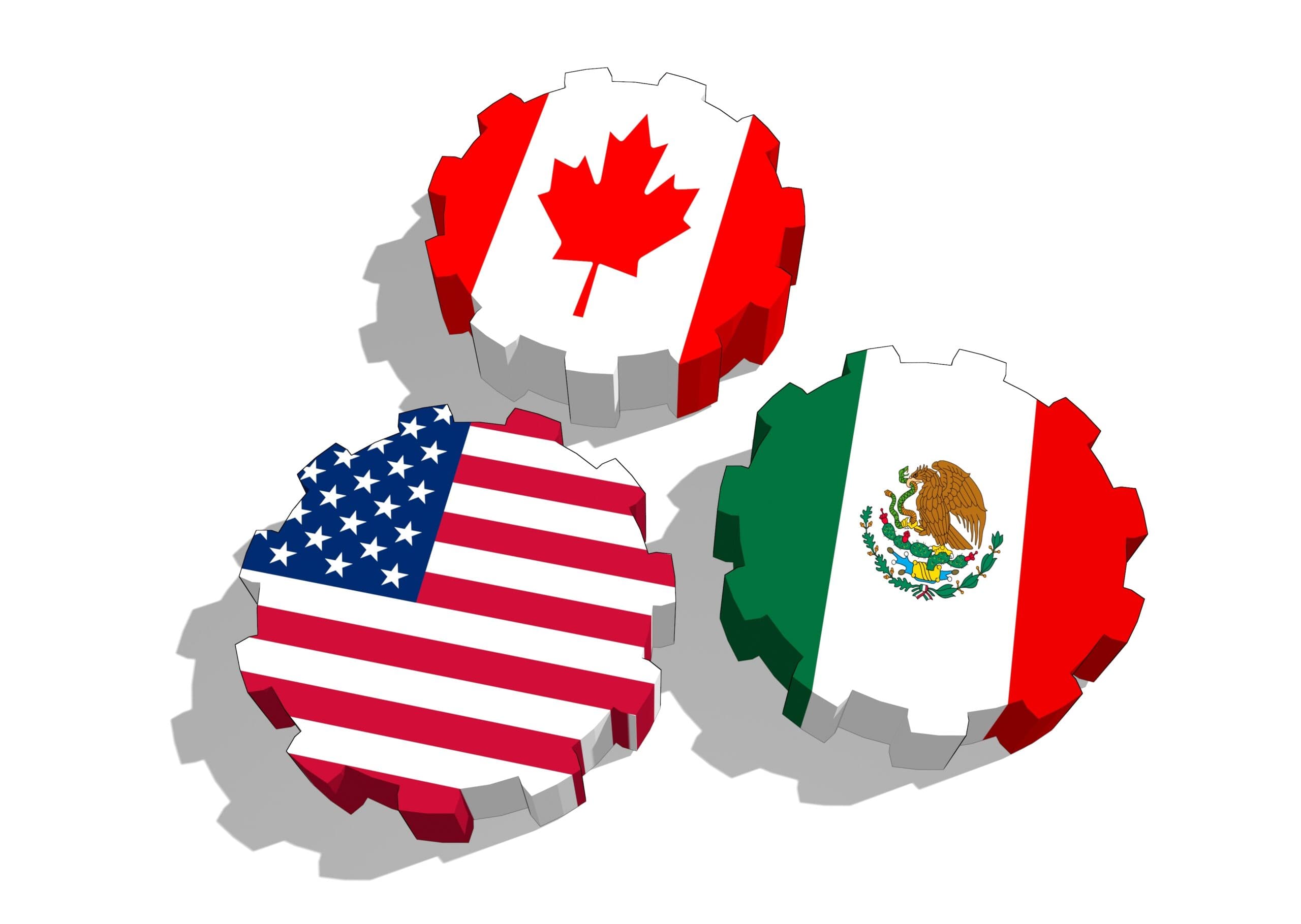
On September 30, 2018, representatives from Canada, Mexico and the United States of America (the “U.S.”), announced that after thirteen months of intense negotiations, the three countries reached a preliminary agreement. This agreement revises the terms of the North American Free Trade Agreement (“the NAFTA”).
The full text of the proposed agreement was published by the U.S. government on October 1, 2018, under the name The United States – Mexico – Canada Agreement (“the USMCA”). Rather than being an amendment to NAFTA, the USMCA is a restatement that supersedes NAFTA.
The USMCA consists of thirty four chapters, whereas NAFTA included twenty two. The new chapters cover labor, the environment, digital trade, data storage requirements, and macroeconomic policies. The USMCA, as currently proposed, is complemented by side letters. These side letters cover how certain products of Canada and Mexico will be treated if the U.S. proceeds to impose additional duties on automobiles and auto parts.
The USMCA’s objectives are to preserve and expand regional trade and production in the region, and facilitate trade between the parties, by promoting efficient and transparent customs procedures. The USMCA is not heavy on tax regulation. It mainly focuses on international trade and customs issues.
Procopio’s International Tax Practice Group analyzed the USMCA in order to identify relevant provisions that may impact our clients and friends. In general terms, the provisions contained in NAFTA regarding investment and immigration did not change substantially. However, there are certain provisions worth mentioning:
INVESTMENT
IMMIGRATION
The most important, novel provisions contained in the USMCA are the following:
We view the USMCA in principle as good news and beneficial for many clients; nevertheless, this was only the first step of the process. The agreement must be executed by the executive branch of the three state-parties and approved by their legislatures. Canada and Mexico will most likely have the agreement approved without much delay. In the case of the U.S., the mid-term elections will be an important factor, because it is not clear if the agreement will have enough votes for its approval. Until the USMCA is passed, NAFTA will remain in effect.
* There is not an express definition of the term “transfer.” USMCA Article 14.9 lists diverse actions that are considered “transfers.” Among the listed actions are the following: contributions to capital, profits, dividends, interest, capital gains, royalty payments, management fees, technical assistance, proceeds from the sale of all or a part of the covered investment, or from the partial or complete liquidation of the covered investment, and payments made under a contract, including payments made pursuant to a loan or employment contract.
** Trusts are expressly acknowledged as enterprises pursuant to USMCA’s Article 1.4 – General Definitions.

Juan advises clients across a wide range of industries on business and corporate matters involving cross-border structuring, mergers and acquisitions, joint ventures, corporate reorganizations, corporate governance, compliance, and commercial contracting. His practice includes guiding clients through transactions that involve Mexican entities, assets, or real property, drawing on his dual licensure in Mexico and California to provide integrated cross-border support.
Juan collaborates closely with clients to implement corporate and transactional strategies tailored to their operational and international needs. Before joining Procopio, Juan spent more than a decade at a leading global law firm, where he practiced in its Corporate M&A group and later was selected to establish and lead its Foreign Trade and Customs practice in the Tijuana office.
Juan advises clients across a wide range of industries on business and corporate matters involving cross-border structuring, mergers and acquisitions, joint ventures, corporate reorganizations, corporate governance, compliance, and commercial contracting. His practice includes guiding clients through transactions that involve Mexican entities, assets, or real property, drawing on his dual licensure in Mexico and California to provide integrated cross-border support.
Juan collaborates closely with clients to implement corporate and transactional strategies tailored to their operational and international needs. Before joining Procopio, Juan spent more than a decade at a leading global law firm, where he practiced in its Corporate M&A group and later was selected to establish and lead its Foreign Trade and Customs practice in the Tijuana office.
Patrick Ross, Senior Manager of Marketing & Communications
EmailP: 619.906.5740
Suzie Jayyusi, Senior Marketing Coordinator Events Planner
EmailP: 619.525.3818
Francisco Sanchez Losada, Marketing and Client Relations Manager
EmailP: 619.515.3225
Sanae Trotter, Senior Manager for Client Relations
EmailP: 650.645.9015