
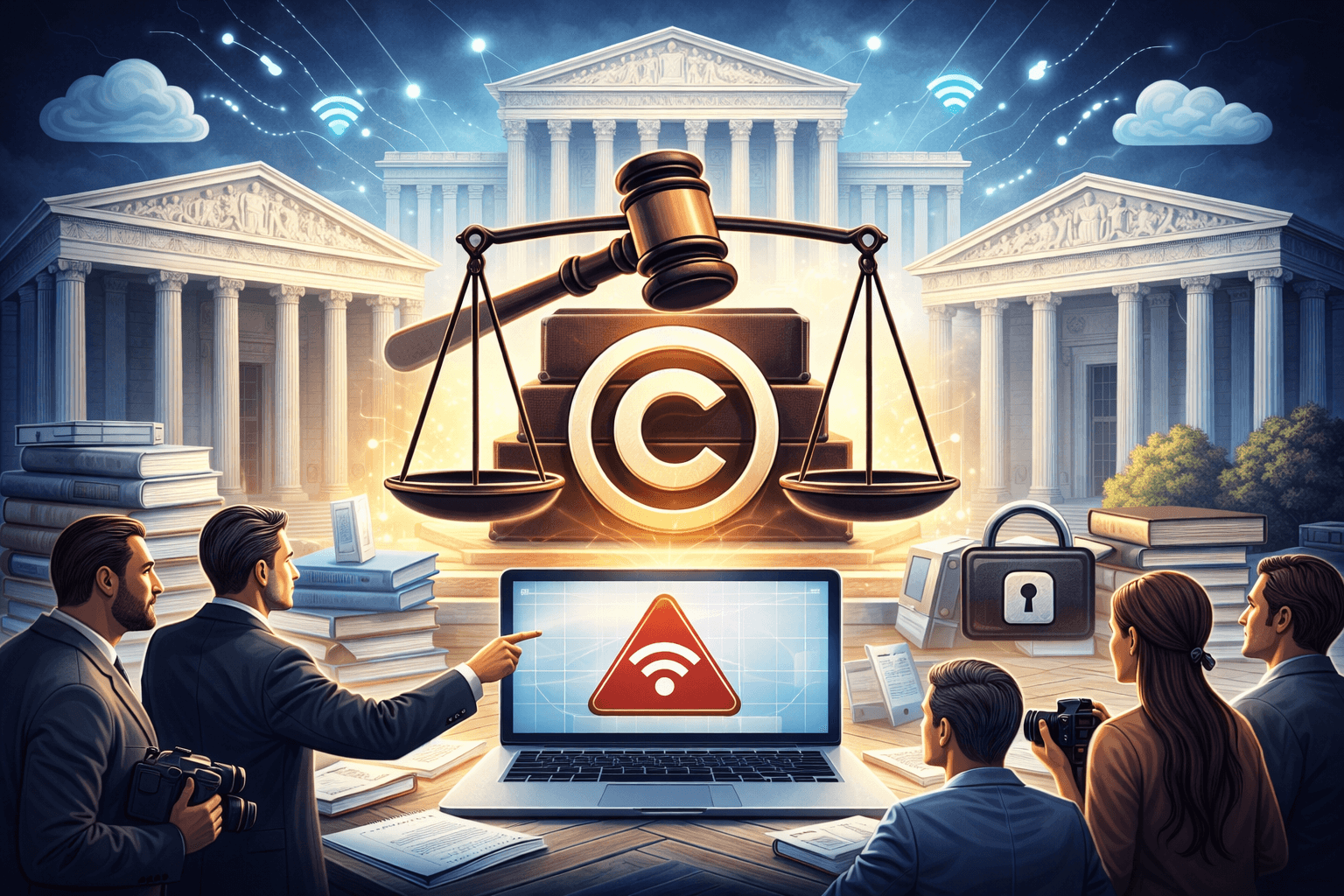
The Supreme Court’s March 25, 2026 decision in Cox Communications, Inc. v. Sony Music Entertainment, 607 U. S. ____ (2026), is a landmark ruling on secondary copyright liability that will affect both rights holders and internet intermediaries. In a 7-2 judgment, the Court held that Cox, an internet service provider, could not be held contributorily liable for continuing to provide internet service to subscribers whose accounts had been tied to infringement notices Cox received. The Court held that contributory liability requires intent, and that intent can be shown only in two ways: inducement or provision of a product or service “tailored” to infringement. Mere knowledge, even knowledge of repeated infringement, is not enough.
The Fourth Circuit had upheld liability on the basis that supplying a product with knowledge that it will be used to infringe is sufficient. The Supreme Court rejected that standard as an improper expansion beyond the Sony (Sony Corp. of America v. Universal City Studios, Inc., 464 U. S. 417, 439 (1984)) and Grokster (Metro-Goldwyn-Mayer Studios Inc. v. Grokster, Ltd., 545 U. S. 913, 930 (2005)) precedents. In Sony, the Court held that VCR makers were not liable for third-party infringement because the technology had substantial non-infringing uses. In Grokster, by contrast, the defendant was found liable because it intentionally courted infringing users. Applying these principles, the Court emphasized that Cox’s broadband service had obvious substantial lawful uses, that Cox did not market its service as a piracy tool, and that failure to terminate service more aggressively did not itself establish the required intent. The Court also rejected the argument that the DMCA’s repeat-infringer safe harbor implied underlying liability; the DMCA creates defenses, the Court said, not a free-standing duty that transforms nontermination into contributory infringement.
The ruling has significant implications for both sides of the intermediary liability debate. For ISPs, cloud services, search engines, marketplaces, hosting providers, and other broad platforms with substantial non-infringing uses, the decision provides meaningful protection against claims based on knowledge of user infringement alone. For copyright holders, the ruling narrows the path to secondary liability: a plaintiff now needs much more than notice, volume, and internal reluctance to cut off customers. It needs evidence that looks like inducement or tailoring-promotion of infringing uses, instructions for infringement, service design choices aimed at infringement, or a business model meaningfully built around infringing activity rather than merely tolerant of it.
In the software licensing context, the decision affects both platforms and enforcement efforts. A marketplace that carries listings or traffic for unauthorized software key resellers is now in a stronger position to resist liability, so long as its service is broadly lawful and it is not actively encouraging infringement. However, the decision does not immunize software key-trafficking; an intermediary that purposefully obtains and resells software keys in violation of license restrictions remains exposed. Direct infringers, sham “resellers,” and entities selling tools or access specifically built for unauthorized activation can still face serious liability. The opinion raises the bar for claims against adjacent intermediaries—but also provides greater clarity about where that bar now sits.
Justice Sotomayor’s concurrence, joined by Justice Kagan, agreed that Cox did not meet the standard for liability but criticized the majority for unnecessarily limiting contributory liability to only two categories that common law, Sony, and Grokster left room for aiding-and-abetting theories. For intermediaries, the concurrence is a reminder that some Justices remain open to broader liability theories. For copyright holders, it offers a potential alternative path. Justice Sotomayor also warned that the majority’s rule may reduce incentives for service providers to implement anti-infringement controls, since if knowledge plus continued service can never create secondary-liability risk, the DMCA’s repeat-infringer safe harbor loses much of its practical significance.
Under the concurrence’s framework, intent to facilitate infringement can be inferred from knowledge when the knowledge is sufficiently specific and the assistance sufficiently culpable. Drawing on Twitter, Inc. v. Taamneh, 598 U. S. 471 (2023), Justice Sotomayor would apply traditional aiding-and-abetting principles, allowing claims where there is a closer fit between what the defendant knew, whom it was helping, and how that help made the infringement succeed. Even so, the concurring Justices find that Cox escapes liability because the notices it received identified only IP connections, not actual human infringers-Cox did not know which person in a household, dorm, or downstream network was infringing. This distinction could matter in future cases where more specific knowledge is shown.
Going forward, the decision provides a clearer framework for both sides. Intermediaries now have greater certainty that general-purpose services will not face liability based on knowledge and inaction alone. Copyright holders should focus on establishing inducement or tailoring—or developing specific, transactional evidence that could support aiding-and-abetting liability. In the software context, for example, that could include evidence that the defendant knew certain keys were unauthorized for resale and nevertheless helped process or route those exact sales.
The Cox decision brings greater clarity to secondary copyright liability-benefiting both intermediaries seeking predictability and copyright holders calibrating enforcement strategies. Future litigation will likely focus on specific knowledge, specific assistance, and a culpable nexus between the defendant’s conduct and the infringing acts. The concurrence may prove influential if plaintiffs can develop records that demonstrate knowing facilitation of specific infringement rather than mere notice-and-inaction.
KEY TAKEAWAYS FOR COPYRIGHT HOLDERS
Build evidentiary records early. Develop specific, transactional evidence tying the defendant to particular infringing activity before initiating litigation. Generic DMCA notices or complaint volume will no longer suffice. Document the defendant’s actual knowledge of specific infringement, promotional conduct suggesting encouragement of infringement, and service design choices facilitating unauthorized uses.
Target the right defendants. Direct infringers remain fully exposed, as do intermediaries that actively induce infringement or tailor their services to unlawful uses. Prioritize claims against parties whose business models or marketing show intentional facilitation rather than mere tolerance.
Leverage the concurrence. Where courts are receptive to aiding-and-abetting theories, Justice Sotomayor’s concurrence offers an alternative path. Develop records emphasizing the specificity of the defendant’s knowledge and the directness of its assistance to particular infringers.
Reassess pending claims. If you have litigation against general-purpose intermediaries based primarily on notice-and-inaction theories, evaluate whether your evidentiary record meets the heightened standard. Consider whether additional discovery could establish inducement, tailoring, or specific knowledge.
KEY TAKEAWAYS FOR INTERNET SERVICE PROVIDERS AND PLATFORMS
Understand your strengthened position. The Cox decision significantly narrows when general-purpose intermediaries can face contributory liability. If your service has substantial lawful uses and you do not actively promote infringement, you are better insulated from claims based solely on receiving infringement notices and failing to terminate users.
Do not abandon reasonable practices. The ruling provides greater protection but does not eliminate all risk. Justice Sotomayor’s concurrence signals that some courts may remain receptive to aiding-and-abetting theories where specific knowledge and culpable assistance can be shown. Maintaining reasonable policies for responding to credible infringement complaints remains prudent.
Preserve DMCA safe harbor compliance. The ruling addresses common-law contributory liability, not the DMCA’s statutory safe harbors. Continued compliance—including maintaining a repeat-infringer policy and designating an agent for takedown notices—remains important for statutory protection.
Avoid conduct suggesting inducement or tailoring. Intermediaries lose protection if they induce infringement or design services to facilitate it. Avoid marketing that could be construed as encouraging unlawful uses, and ensure service features are not specifically designed to enable infringement.

Mindy focuses on intellectual property, data privacy, internet, and healthcare litigation. She helps companies from funded start-ups to public companies handle trade secret, privacy, copyright, trademark, patent, and complex commercial disputes. Mindy frequently assists with complex commercial litigation involving software contracts, intellectual property licenses, and non-compete agreements.
Intellectual Property: In addition to managing litigation involving all matters of IP, Mindy serves as a senior editor for Sedona Conference’s Working Group 12 on trade secrets and chairs the ABA IP Section’s Trade Secrets Committee. She leads Procopio’s Trade Secrets practice group.
Data Privacy: Mindy defends companies with an online presence against individual, class action/mass arbitrations and lawsuits filed under CIPA (California Invasion of Privacy Act) and related laws. These trap and trace cases allege wiretapping and invasion of privacy through use of web chats, session replay, cookies, pixels, and pen registers.
Internet: Mindy defends internet companies against lawsuits based on user posts, and is a passionate defender of CDA Section 230. This includes claims of defamation, copyright and similar claims on First Amendment, DMCA and US SPEECH Act grounds. She also contributed to an ABA book on Social Media Law.
Health Care: Mindy defends healthcare entities against claims brought by physicians and staff and provides advice regarding medical staff matters. She also litigates healthcare technology, medtech, retaliation, and medical device cases. Mindy leads Procopio’s Health Care sector group.
Mindy focuses on intellectual property, data privacy, internet, and healthcare litigation. She helps companies from funded start-ups to public companies handle trade secret, privacy, copyright, trademark, patent, and complex commercial disputes. Mindy frequently assists with complex commercial litigation involving software contracts, intellectual property licenses, and non-compete agreements.
Intellectual Property: In addition to managing litigation involving all matters of IP, Mindy serves as a senior editor for Sedona Conference’s Working Group 12 on trade secrets and chairs the ABA IP Section’s Trade Secrets Committee. She leads Procopio’s Trade Secrets practice group.
Data Privacy: Mindy defends companies with an online presence against individual, class action/mass arbitrations and lawsuits filed under CIPA (California Invasion of Privacy Act) and related laws. These trap and trace cases allege wiretapping and invasion of privacy through use of web chats, session replay, cookies, pixels, and pen registers.
Internet: Mindy defends internet companies against lawsuits based on user posts, and is a passionate defender of CDA Section 230. This includes claims of defamation, copyright and similar claims on First Amendment, DMCA and US SPEECH Act grounds. She also contributed to an ABA book on Social Media Law.
Health Care: Mindy defends healthcare entities against claims brought by physicians and staff and provides advice regarding medical staff matters. She also litigates healthcare technology, medtech, retaliation, and medical device cases. Mindy leads Procopio’s Health Care sector group.

Lyndsey represents companies and business owners in high stakes intellectual property and complex commercial disputes, with a practice centered on protecting brands, technology, and competitive advantage. She litigates matters involving trade secrets, trademarks, copyright, patents, counterfeiting, unfair competition, employee fraud, and intellectual property theft, and she regularly advises clients on practical, effective enforcement strategies to stop infringement and misuse before it escalates.
Lyndsey works with clients across a wide range of industries, including enterprise and networking technology, consumer electronics, wearable technology, internet service providers, textile and industrial manufacturing, securities, and financial payments technology. She handles cases from first filing through appeal. Lyndsey has tried bench and jury cases in both state and federal courts in California and New York and has handled appeals before the Ninth and Second Circuits. In addition to intellectual property litigation, she prosecutes and defends complex commercial cases involving high exposure and sophisticated legal issues.
Lyndsey represents companies and business owners in high stakes intellectual property and complex commercial disputes, with a practice centered on protecting brands, technology, and competitive advantage. She litigates matters involving trade secrets, trademarks, copyright, patents, counterfeiting, unfair competition, employee fraud, and intellectual property theft, and she regularly advises clients on practical, effective enforcement strategies to stop infringement and misuse before it escalates.
Lyndsey works with clients across a wide range of industries, including enterprise and networking technology, consumer electronics, wearable technology, internet service providers, textile and industrial manufacturing, securities, and financial payments technology. She handles cases from first filing through appeal. Lyndsey has tried bench and jury cases in both state and federal courts in California and New York and has handled appeals before the Ninth and Second Circuits. In addition to intellectual property litigation, she prosecutes and defends complex commercial cases involving high exposure and sophisticated legal issues.
Patrick Ross, Senior Manager of Marketing & Communications
EmailP: 619.906.5740
Suzie Jayyusi, Senior Marketing Coordinator Events Planner
EmailP: 619.525.3818
Francisco Sanchez Losada, Marketing and Client Relations Manager
EmailP: 619.515.3225
Sanae Trotter, Senior Manager for Client Relations
EmailP: 650.645.9015