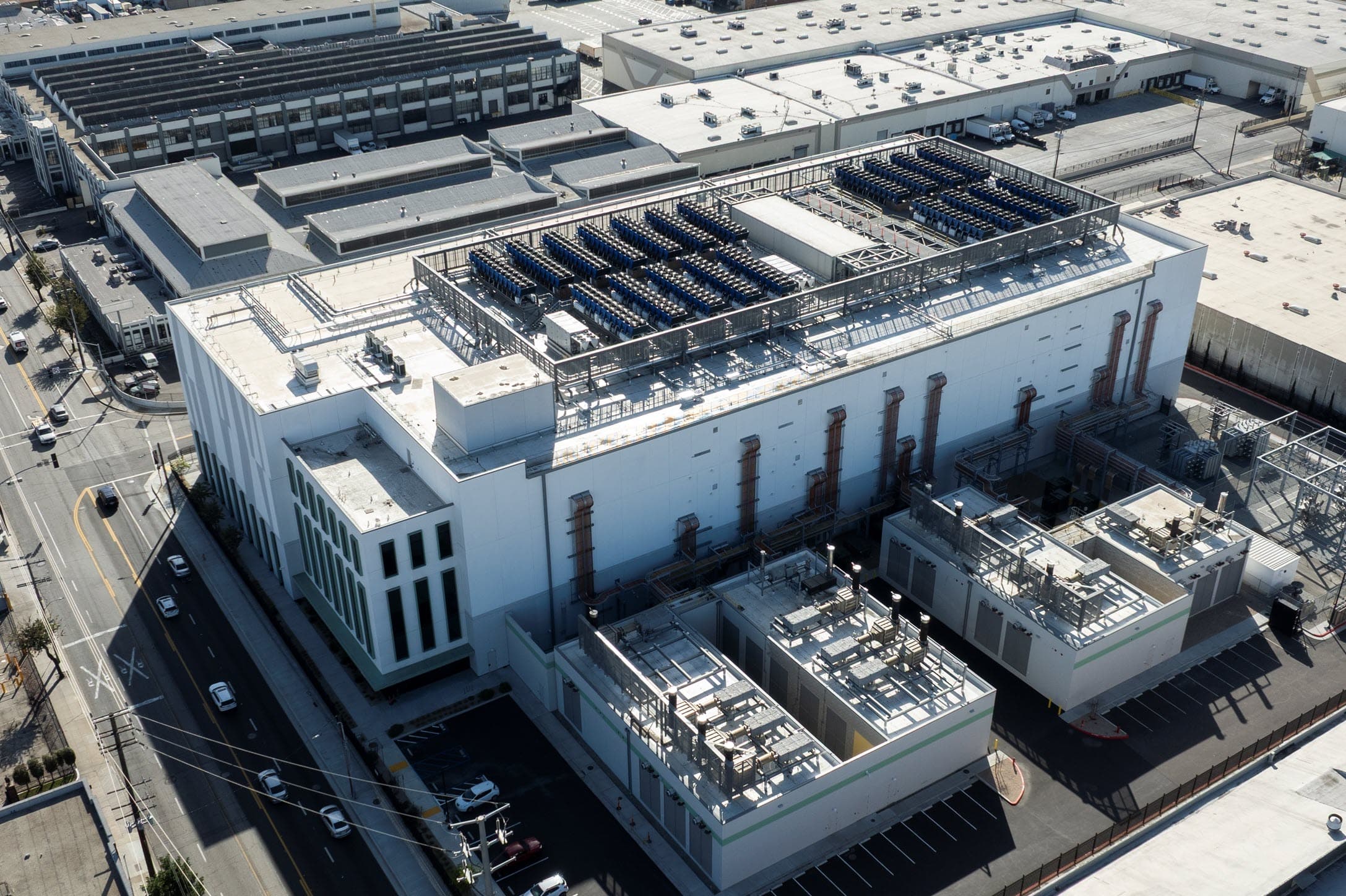


Data center developers, investors, and communities across California face a changing development landscape as new requirements impact some of the industry’s most consequential land use and infrastructure issues.
Governor Gavin Newsom signed a package of seven bills (AB 1577 – Bauer-Kahan; AB 2383 – Zbur; AB 2469 – Papan; AB 2619 – Papan; SB 886 – Padilla and McNerney; SB 887 – Padilla; SB 1168 – McNerney) on September 21 addressing the electricity, water, and environmental impacts of data centers. The new laws impose additional reporting requirements, address responsibility for electric grid and water infrastructure costs, and establish conditions data center projects must meet to qualify for streamlined judicial review under the California Environmental Quality Act (CEQA).
But the significance for developers extends beyond the individual requirements contained in the legislation. At the state level, California is establishing a framework seeking to address questions about power capacity, water supply, infrastructure, environmental review, and community impacts. At the same time, various cities and counties are taking their own approaches to data center development, creating a patchwork of local regulatory landscapes that can vary considerably from one jurisdiction to another.
The result is an increasingly complicated development environment. While a site may appear suitable from a real estate or engineering perspective, depending on the local rules, the entitlement process can vary from straightforward to incredibly complex. Two near-identical sites in different locations may face entirely dissimilar entitlement paths depending on the jurisdiction’s rules, available infrastructure, and local response to data center development. Early diligence is thus key to a successful data center project.
According to the state, the legislative package is intended to provide communities with more information about proposed projects while protecting utility customers from costs associated with data center growth. Specifically, the seven bills address data centers through three closely related areas: electricity, water, and environmental impacts.
On electricity, the legislation addresses grid upgrade costs, energy procurement, and rate structures. The state says the new laws are intended to prevent costs associated with serving data centers from being shifted to other ratepayers, and the laws require projects to pay for necessary grid upgrades and comply with California energy procurement requirements. For water, proposed data centers must provide information to local governments and water suppliers about water use, supply, efficiency, and drought planning, and the projects will be responsible for upgrades needed to provide water service. Regarding environmental review, the legislation clarifies that data centers are not categorically exempt from CEQA. At the same time, the legislation also allows for expedited judicial review for qualifying data centers that meet certain environmental requirements. Projects must demonstrate that they meet state standards involving energy, water, and fuel consumption and will not shift costs to ratepayers before qualifying for that treatment.
For developers, the new legislation means that infrastructure planning must become part of site selection and entitlement strategy early in the process.
For example, data centers are energy-intensive, with the largest data centers typically including onsite power generation. However, proper energy planning also requires understanding available natural gas supplies, grid connectivity requirements with the local power provider, if desired, and a host of related regulatory requirements. California’s new framework is intended to prevent data center costs from being shifted to other ratepayers, meaning that when deciding whether a project is feasible, developers must consider all aspects of energy costs and availability early in the planning process.
Water presents a similar issue. The new disclosure requirements mean that developers should be prepared to address anticipated water use and its relationship to local supply, efficiency, and drought planning. For developers evaluating competing sites, the relevant questions extend beyond whether water service exists. The availability and reliability of that supply, anticipated demand, and cost of necessary improvements may all affect project feasibility.
CEQA adds another layer. The new legislation makes clear that developers should be prepared to engage in robust environmental review for virtually all data center projects, and that the potential for streamlined judicial review is deeply intertwined with questions about energy, water, fuel consumption, and infrastructure costs.
Taken together, the laws reinforce a broader trend in data center development: data centers are no longer primarily a technology issue. They involve significant land use and infrastructure issues, with decisions about where and how facilities are developed increasingly tied to the capacity and priorities of the communities around them. Thus, California’s new laws make it clear that infrastructure and land use analysis should not be treated as separate tracks. They increasingly need to inform one another early in the strategy process.
The new state laws establish a broader framework, but they do not create a uniform entitlement process across California. Developers must still navigate the land use requirements of the city or county in which a project is proposed.
That local landscape is evolving rapidly. Some jurisdictions are reconsidering how, where, and even if data centers should be permitted, while others are continuing to process projects under existing rules. For a developer, that means statewide compliance is only one part of the regulatory analysis.
Before committing significant resources to a site, a development team should understand the existing zoning and general plan designations, what discretionary approvals will be required, whether local rules affecting data centers may be changing, and how the proposed project is likely to be received by local decision-makers and the surrounding community. Additionally, infrastructure diligence should proceed alongside this land use analysis. Energy availability and interconnection, water supply, necessary infrastructure improvements, and responsibility for those costs can all affect whether an otherwise promising site remains viable.
Timing can matter as well. Because local policies can change during the planning process, developers should consider the status of local regulations before making significant commitments to a particular site.
The changing regulatory environment also creates potential litigation risk, particularly when questions arise over CEQA review, project approvals, and the relationship between existing zoning and a project’s broader environmental impacts.
A recent Imperial County case provides a real-world example of the issues that can arise when a large data center is proposed on land where the underlying use is interpreted as permitted by existing zoning. A developer proposed a roughly 950,000-square-foot data center campus, supported by a 330-megawatt substation with an emergency-generation facility and an 862-megawatt-hour battery energy storage system, on approximately 75 acres of land in unincorporated Imperial County. The County treated the project as a ministerial, by-right development exempt from project-level CEQA review. The City of Imperial and the Sierra Club challenged that approach, arguing that the project’s interconnected components, including its battery storage, generation, electrical infrastructure and water-related facilities, needed to be evaluated together under CEQA.
In September 2026, an Imperial County Superior Court judge ruled that the County prejudicially abused its discretion by approving the lot merger without first completing the CEQA review required for the project as a whole. The court concluded that the record supported a fair argument that the project could cause significant environmental effects, including effects associated with energy and electrical infrastructure, water, air quality and other resources, and required preparation of an environmental impact report. The ruling substantially reset the project’s entitlement path, although the court made clear it was not ordering the County to approve or deny the project and was not predetermining what mitigation measures or project alternatives might ultimately apply during the environmental review process. The developer has said they intend to seek a new trial and, if unsuccessful, appeal.
The project has also been the subject of separate litigation over Imperial County’s emergency moratorium on new data-center approvals. In that case, a separate Superior Court judge concluded that the emergency ordinances failed to make the findings required by Government Code section 65858(c), including a finding establishing a current and immediate threat to public health, safety or welfare resulting from the approvals the ordinances sought to pause. The judge ordered the County to set aside and cease enforcing both ordinances. Together, the two cases illustrate a broader point for data-center developers and local agencies: existing zoning may establish that a use is permitted, but it does not avoid the time, cost, and CEQA litigation risks, particularly where a proposal includes substantial interconnected infrastructure. They also demonstrate how CEQA litigation and local land-use regulation can create separate, but overlapping, sources of entitlement risk.
The broader point for developers is that zoning is only one component of data center development. A project that appears consistent with existing land use regulations may still face questions involving environmental review, infrastructure, project scope, and community impacts.
For developers and investors considering California sites, the changing landscape puts a premium on early diligence. The question is no longer simply whether a parcel can accommodate a data center. Developers must also determine whether the necessary power and water can be delivered on a workable timeline, what infrastructure improvements will be required, how CEQA will apply, whether local regulations may change, and what issues are likely to emerge during public review. Community and political considerations may also impact site selection long before an entitlement application has been filed.
Thus, before moving deeply into design or entitlement work, a development team should be asking several interconnected questions:
These questions can influence not only whether a project is ultimately approved, but whether a site makes sense to even consider in the first place. A parcel with favorable zoning may prove less attractive once power, water, infrastructure, and entitlement risks are considered together. Conversely, a jurisdiction with a more demanding entitlement process may offer greater certainty if its requirements and infrastructure expectations are clearly established.
Early coordination among land use counsel, environmental consultants, utilities, engineers, and local agencies can help identify issues before they become obstacles. Before acquiring a site or advancing entitlement applications, developers should identify regulatory and infrastructure risks, compare potential locations, and develop an entitlement strategy suited to California’s changing data center landscape.

Shawna has a broad environmental law practice, focusing on land use, project siting, and litigation. She advises clients on a wide range of complex environmental regulatory matters, including compliance with the California Environmental Quality Act (CEQA), National Environmental Policy Act (NEPA), California Coastal Act, Housing Accountability Act, Clean Water Act, Endangered Species Act, and other state and federal regulatory requirements. She also has significant experience with environmental litigation.
Shawna graduated from the UCLA School of Law, completing specializations in Environmental Law and the David J. Epstein Program in Public Interest Law & Policy. In addition, she served as an editor for the Journal of Environmental Law & Policy and on the Board of Law Women of UCLA. She previously served as a law clerk for the Environmental Enforcement Section of the U.S. Department of Justice.
Shawna has a broad environmental law practice, focusing on land use, project siting, and litigation. She advises clients on a wide range of complex environmental regulatory matters, including compliance with the California Environmental Quality Act (CEQA), National Environmental Policy Act (NEPA), California Coastal Act, Housing Accountability Act, Clean Water Act, Endangered Species Act, and other state and federal regulatory requirements. She also has significant experience with environmental litigation.
Shawna graduated from the UCLA School of Law, completing specializations in Environmental Law and the David J. Epstein Program in Public Interest Law & Policy. In addition, she served as an editor for the Journal of Environmental Law & Policy and on the Board of Law Women of UCLA. She previously served as a law clerk for the Environmental Enforcement Section of the U.S. Department of Justice.

Daniel “Rock” Rockholt is a seasoned urban, educational and military facilities planner with over 25 years experience working in both the public and private sectors for urban, regional, military and educational facilities master planning. The depth of his knowledge is rooted in his widespread experience and ranges from resiliency, climate-action planning (in relation to urban and transportation systems), educational facilities planning, and operational planning.
In addition to his highly successful career as a master planner, Daniel’s impressive military background includes serving as Deputy Director of Intelligence Operations, Situational Awareness Room (SAR), and RS HQ. In his over 30 years of service, “Rock” was a monumental leader in his held positions as Assistant Chief-of-Staff, Department Head, Division Officer and Intelligence Federation Manager.
Daniel is also an established artist as an award-winning photographer specializing in architectural, nature, landscape, and fine art photography with works in galleries and museums in California and abroad.
Daniel “Rock” Rockholt is a seasoned urban, educational and military facilities planner with over 25 years experience working in both the public and private sectors for urban, regional, military and educational facilities master planning. The depth of his knowledge is rooted in his widespread experience and ranges from resiliency, climate-action planning (in relation to urban and transportation systems), educational facilities planning, and operational planning.
In addition to his highly successful career as a master planner, Daniel’s impressive military background includes serving as Deputy Director of Intelligence Operations, Situational Awareness Room (SAR), and RS HQ. In his over 30 years of service, “Rock” was a monumental leader in his held positions as Assistant Chief-of-Staff, Department Head, Division Officer and Intelligence Federation Manager.
Daniel is also an established artist as an award-winning photographer specializing in architectural, nature, landscape, and fine art photography with works in galleries and museums in California and abroad.
Patrick Ross, Senior Manager of Marketing & Communications
EmailP: 619.906.5740
Suzie Jayyusi, Senior Marketing Coordinator Events Planner
EmailP: 619.525.3818
Francisco Sanchez Losada, Marketing and Client Relations Manager
EmailP: 619.515.3225
Sanae Trotter, Senior Manager for Client Relations
EmailP: 650.645.9015